

In a world often divided by opinions and beliefs, Encouraged Conversations is one step towards fostering understanding between groups through open and respectful communication
This is a volunteer project looking at areas of public discourse where there are group feelings of Them and Us. In the world today, there are a lot of strong opinions and beliefs about different social issues aired on all kinds of media. Sadly, there are also misunderstandings and there is misinformation. This project aims to help us understand more about other people’s opinions and beliefs by asking questions and listening to the answers using anonymous audio recordings of ‘fly on the wall’ conversations.
Creating the Conversations
Wherever ‘Them and Us’ groups emerge, there is an opportunity for an Encouraged Conversation. Groups that are willing to engage with each other indirectly and through a third party are identified. One group generates a list of questions to ask the other group. A third party takes these questions in hard copy to the other group to answer freely amongst their friends in a private place. The conversation is audio-recorded, keeping everyone anonymous so they can speak frankly and feel safe. The resulting conversations can be personal, revealing and engaging in a way that is not possible when people are under scrutiny in a public space.
The recording is then processed and after approvals and safeguards are met, it is published and then made available for others to listen to.
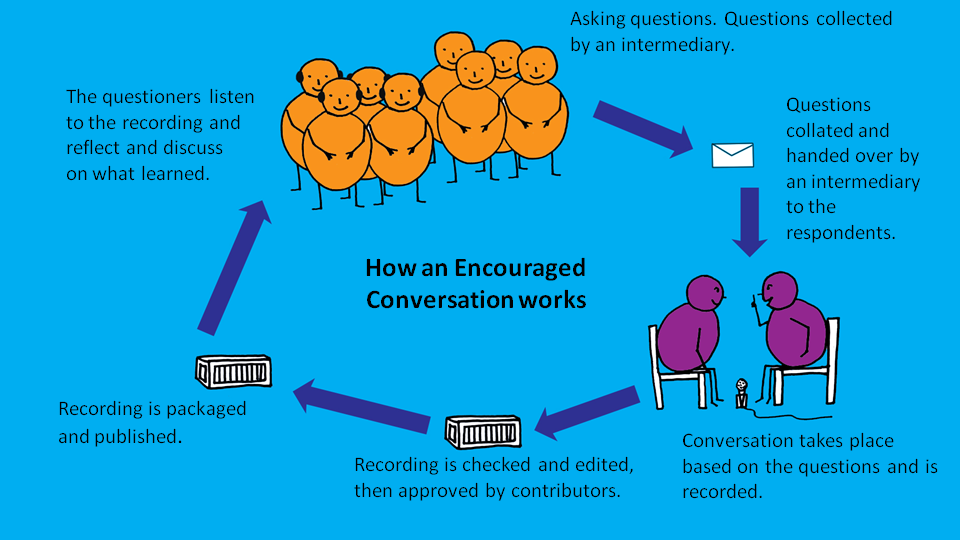
Impact studies
Durham University and Dundee University Psychology Departments are developing research and teaching projects in the field of Intergroup Relations to scientifically evaluate the impact of the Encouraged Conversation model. The research is ongoing and the results are expected later this year.
The people behind the scenes
Encouraged Conversations has been developed by Wendy E. Ball as a personal response to the seemingly prevalent mood of distrust and polarised hostility in our society today. Consulting with a wide variety of individuals and organisations in academic and community fields on the subject of personal identity and intergroup dialogue, research showed that contact between groups in the right context can make dialogue more tolerant and nuanced in understanding. So, based on oral history practice, Wendy developed the Encouraged Conversation model as a potential first step in intergroup contact.
Wendy has a wide range of experience in many varied fields including teaching, community education, educational resources, research, archives, archaeology, oral history, heritage interpretation, illustration, publishing, editing and her interests include writing and travelling to eat – all leading her to encouraged conversations.
Further development on the business and technical side of Encouraged Conversations has been made possible with the help of Olubunmi S. Akomolafe of the Scottish Tech Army and Will Finlayson.
 Encouraged Conversations